Boundaries of Bukan’s Qalaichi site approved
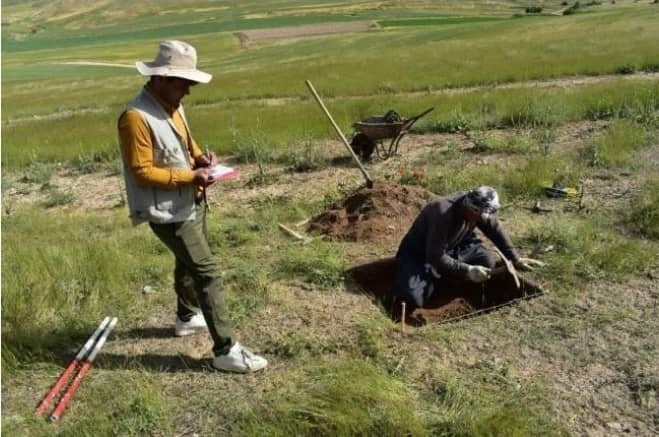
TEHRAN--The boundaries of Qalaichi archaeological site in Bukan, West Azarbaijan province, were approved by Ministry of Cultural Heritage, Tourism and Handicrafts for global registration.
According to IRIB, the decision was made on February 9, 2026, after review and approval by the technical committee, in the presence of experts from various fields, and was approved after the expert discussions and studies.
Determining the exact boundaries of the historical sites is one of the most important legal tasks in the field of cultural heritage, which plays a fundamental role in protecting, managing and preventing any encroachment and interference with historical monuments.
The approval of the area and boundaries of Qalaichi hill was carried out within the framework of necessary executive measures in order to provide legal and protective bases for the global registration of the Mannaean axis.
Qalaichi necropolis is considered one of the most significant historical sites in Bukan county in the northwest region of the country, and the approval of its area and boundaries will pave the way for more effective protection and principled planning for the site.
By specifying the designated area and boundaries, it will be possible to coordinate development and construction plans with cultural heritage regulations, and possible damage to this historical site will be prevented.
The first archaeological season was carried out at an ancient necropolis associated with the Qalaichi site in June 2024. It was once the capital of the Mannaean kingdom from the 10th to 7th centuries BC.
Situated in northwestern Iran, close to Lake Urmia, Qalaichi is renowned for its glazed bricks looted and smuggled out of Iran about four decades ago but were repatriated with the assistance of Swiss officials in December 2020.
According to CHTN, the excavation commenced in May 2024 following damage to the Qalaichi necropolis. The dig has received authorization from the Research Institute of Cultural Heritage and Tourism and support from the municipality of Bukan and the tourism directorate of West Azarbaijan province.
Yousef Hassanzadeh, the lead archaeologist, said: “Despite nine previous excavation seasons at Qalaichi from 1985 to 2006, led by esteemed archaeologists Ismail Yaghmaei and Bahman Kargar, the necropolis had not been explored until now.”
He added the Qalaichi site, dating back 2,800 years to the Mannaean kingdom, gained fame for the exquisite glazed bricks discovered there.
The inaugural season of research in the necropolis, backed extensively by Bukan’s municipality and in collaboration with West Azarbaijan’s tourism directorate, aimed to investigate the architectural structure of the graves and the burial practices of the Mannaean people.
In conclusion, Hassanzadeh expressed optimism that the Qalaichi site and its necropolis could be developed into a tourism complex.
In the 1970s, a farmer plowing at Qalaichi came across a decorated brick, probably from the columned hall of a citadel. This discovery led to extremely damaging illegal excavations, partly using a bulldozer. Eventually, in 1985, there was an official rescue excavation, but this was quickly abandoned because of an intensification of the Iran-Iraq War. There were then 14 more years of illegal digging until 1999, when there was another official excavation. But by this time, only small fragments of broken bricks were found.
Situated about nine air km northwest of Bukan, Qalaichi (or Ghalay-chi) is an ancient settlement so far yielded a large number of glazed objects. Some of which are monochrome and the others show complex compositions. The glazed objects from the regular excavations were curated in Urmia Museum and Tehran National Museum.
The artifacts are connected to the Mannai civilization, which flourished in northwestern Iran in the 1st millennium BC. Mannai, also spelled Manna, was an ancient country surrounded by three major powers of the time, namely Assyria, Urartu, and Media.
According to the Encyclopedia Britannica, the Mannaeans are first recorded in the annals of the Assyrian king Shalmaneser III (reigned 858–824 BC) and are last mentioned in Urartu by Rusa II (reigned 685–645 BC) and in Assyria by Esarhaddon (reigned 680–669 BC). With the intrusion of the Scythians and the rise of the Medes in the 7th century, the Manneans lost their identity and were subsumed under the term Medes.
KD
Leave a Comment